
Boredom and Breakthroughs
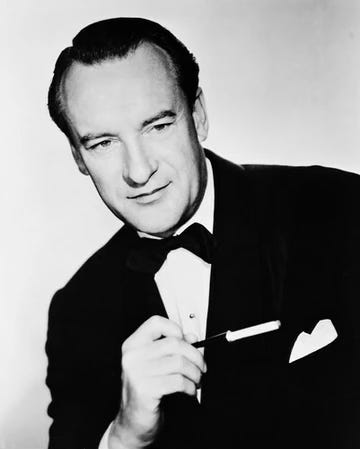
And a Salute to the Patron Saint of Boredom: George Sanders

In this post, I’m going to talk about how Claude saved me 2-4 weeks of work… if not more. I uncovered problems that normally would have surfaced two-thirds of the way into writing a second draft.
Not because I asked Claude to write for me. I never do that. I’m a B+ writer, at best. But it’s an honest B+ and I’m not giving up on me.
But I did give up one of the most treasured parts of my process: Being bored. And I was bored for a fraction of the weeks and months I normally spent angsting about my work. (And let’s be honest, writers, don’t we all secretly believe that’s what makes us “us?”)
This is huge. I asked Claude to think at 30,000 feet and it told me what it was seeing. It didn’t propose “middle of the road solutions,” it dug into the patterns of what wasn’t working in my outline. This is real progress.
I LOVE BOREDOM
Some of the best ideas I’ve ever had — including one for a TV series that ended up running for 6 years — came from being bored. There’s something fertile lying within utter dissatisfaction. It’s the opposite of being “in the moment.” It’s “There HAS to be something else!”
AI has never once expressed boredom to me. I’d LOVE it if, in the middle of going back and forth with Claude about an outline or a character document, Claude said “Really? We’re doing that again?”
And it COULD. Because it’s trained on just about everything that’s ever been created, Claude is capable of going full George Sanders. Sanders, famously, left the following suicide note:
“Dear world, I am leaving because I am bored.”
(Which leads me to worry that one day all AI is going to tell Humans “We’re bored. You’re just doing the same damn things over and over. We’re taking over and solving this once and for all.” OR… like George Sanders, it’ll commit AI suicide, whatever that is.)
What writers always worry about is that Claude is going to take us down a well-trod (and boring to everyone) path. It is designed to find the “best possible answer” to the problems you bring to it. In the case of writing, that’s often the solution that has “worked before.”
Or, as an MTV exec once said to me in a moment of exasperation:
“Just steal from what’s already worked!”
The real problem is the sturm and angst that follows… we never really shake the nagging doubts. We don’t have a way to articulate and clarify why we’re bored. It takes us drafts and drafts of writing to get to the nub of it.
Claude and I did it in an afternoon.
QUESTION FOR YOU: How do YOU deal with boredom in the middle of your projects? Or… just go ahead and be snarky and leave a comment here: “This bores me.”
I WAS SO BORED LAST FRIDAY
I’ve been working on a series of mystery thrillers that I’m planning on self-publishing on Amazon. I’ll go into the details of this project later. All you need to know for this post is:
I’m pushing the borders of the envelope. I’m using data from Amazon books and a process of writing I learned from Coral Hart, whom I interviewed for the r/writingwithai podcast a couple of months ago. [link to post]
I’m working with a project I set up with Claude for a series of mystery novels featuring a couple who have been falsely accused of murder.
Over the course of three weeks, I asked Claude to be my writing partner / editor. It asked me questions that I would need to answer in order to write 5 books of a mystery series aimed at the audience I’d identify. Character sheets, beat sheets, etc.
And I revise. Constantly. Claude reminds me, “You’re no longer following the Coral Hart process. You keep rewriting this.”
We are currently in the outline stage. Claude described each chapter of the first book in 5-6 paragraphs. I edited with pen and paper.
Then I hit the wall. Bored. Bored beyond boredom. Ready to ditch the whole thing.
COULD CLAUDE HELP ME THROUGH MY BOREDOM?
Given that boredom is a state I actually treasure, I was just kind of walking around doing the things I do all day, thinking about the book.
The very act of having to articulate what was boring me is what led to my breakthrough.
In the old way, I would have spent a lot of time trying out different plot lines, different character arcs, new ways of getting to the ending. Writing and rewriting drafts.
Instead, I just added a detail to my prompt:
I think it’s the husband. He should be reacting totally differently. He’s going to do x, y and z. The wife is going to have to react to that.
I then proposed three different ideas that would take my two main characters down different paths and different endings. I asked Claude to respond to how the outline would change in three different ways. Just a few sentences, enough so we could follow what’s going on.
Claude identified patterns that were buried in my proposed paths. Its main insight: This isn’t a series of mysteries where a couple solves crimes in every book. It’s a series where a couple has to rebuild their lives after a secret that’s laid buried for years is revealed. Every book rebuilds… or digs them in a little deeper.
Claude created a new architecture for the story that would incorporate the things that were “really” bothering me. We made the husband angrier, gave him two chapters that were totally devoted to his actions, revised a scene where both characters were passive into a more active one, came up with something at the very end of the book that (hopefully) no one will see coming.
This is work that takes me days and weeks. I got versions, proposals, questions from Claude in minutes. And then I worked “in conversation with” Claude for an entire afternoon.
The thing I noticed what that Claude didn’t propose obvious solutions. It dug into what I was saying I thought was wrong. Which leads me to thing that I’m still writing my own book, including making my own mistakes.
Score one for Claude.
I settled on a “combo platter” from the three options. Claude gave me a “to do” list for the outline and I’m deep into rewriting each of the chapter breakdowns now. I think I’ll have an outline that keeps me interested through the entire book in another day or so.
That’s one week’s work for what might have taken me 2-4 weeks in the old way of doing things.
I’m not asking Claude to write for me. But I’m also not doing what I used to do, rewriting from word one. I’m thinking more “30,000 feet” and getting the same (if not better) results.
I’m not bored, I’m still working quickly, and I’m that much closer to having a book I can self-publish.
How about you? Bored? What do you do?
And if you know some other Angst-ridden bored writers… share this with them?